
Welcome to Part 2 of the Introduction to Intelligent Communication Course. If you are new to this course and have not yet completed the first lesson, you can find a link to that lesson at the bottom of this article. Go there first and complete that lesson before working through this one.
If you have already completed lesson 1, “Did you take some time to think about being more deliberate in your communication?”
After teaching the Intelligent Communication model for a few years, I realized just how effective it was in helping my students become more effective communicators. They were able to maximize the use of communication to achieve their goals and objectives. Many of my students began commenting on how effective the model was in improving their personal interactions as well as their professional contacts.
I wanted to make the model available to a broader audience to use in both their personal and professional lives. I found, however, that many people did not relate to the model’s terminology. This was particularly true of people without any experience in the military and intelligence fields.
Intelligent Communication 2.0 — Smart Talk
I decided to modify the original model to make it easy for people without military and intelligence backgrounds to understand. This included young people, as I had the opportunity to teach the approach to a few groups of high school students. My goal was a simplified model that was even easier to apply. The result was Smart Talk (see the graphic below).
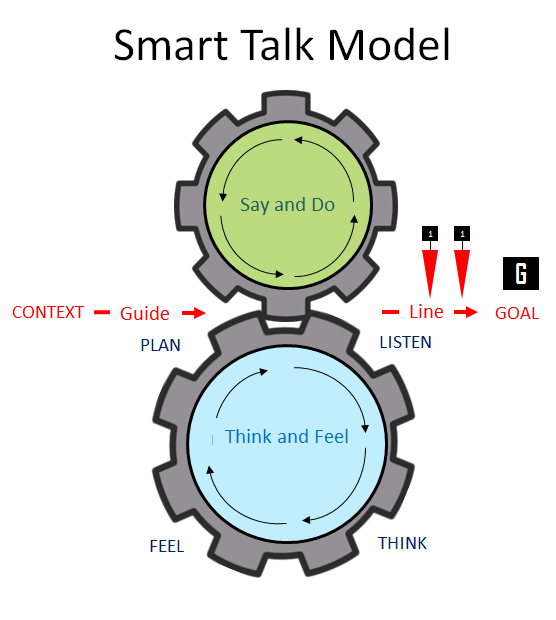
Smart Talk – Three Parts
Smart Talk had the same basic structure and flow as the original Intelligent Communication model. My goal with Smart Talk was to simplify the model using concepts that were, for the most part, self-explanatory. The three parts of Smart Talk were:
- The Guideline (originally the Line) – guides our communication and provides focus; beginning with the context through to achieving our goal for the interaction.
- Think and Feel (originally the Exploitation Cycle) – describes the internal processes we use to better understand others and determine the proper response. There are four steps to this part of the model.
- Say and Do (originally Collection) – consists of the deliberate actions we take, based on our understanding, to move the interaction towards our objectives and ultimately our goal.
The flow of the model is the same as the original Intelligent Communication model. For every interaction, we want to move along the Guideline from context to achieving our goal. The two cogwheels (Say & Do and Think & Feel) drive the interaction along the Guideline towards our objectives and ultimate goal.
Note that the Think & Feel cogwheel is a little larger than the Say & Do cogwheel. I do this for emphasis. First of all, the processes involved in Think & Feel are those we often neglect; making our communication much less effective. Further, I have found that most communication training programs focus on Say & Do. The problem with this is that if we do not Think & Feel, we will not know what to Say & Do to move the interaction towards our goal.
Intelligent Communication 3.0
More recently, I have integrated Intelligent Communication into new areas, such as identifying and mitigating insider threats in companies and organizations (stay tuned for this topic coming to Intelligent Communication online training center). This involved using the model from different perspectives. It is not only a guide for our communication, but can also provide a model through which we consider others’ communication and behaviors. The result of this was a few further refinements in the model.
The basic ideas of Intelligent Communication have remained through all versions of the model. The latest version simply represents refinements that expand the applications of the model. The guideline component remains basically the same as in the previous version. The Say and Do component is also basically the same, though I refer to this as the Body or Behavior.
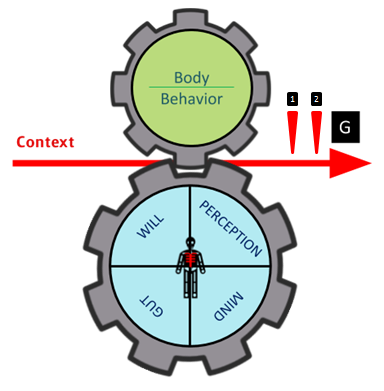
The biggest change is in the larger cogwheel. This is not surprising, as it has always been the focus of Intelligent Communication. In this latest version, this component represents our inner person, which I refer to as our heart. I then break down the heart into four parts: Perception (taking in data); Mind (thinking); Gut (feeling); and Will (deciding). This idea of the inner person is based on an ancient view of anthropology that I think is still quite valuable today. As you will see, even this component retains the general focus of the preceding versions.
Before you move on to the practical exercise, take some time to absorb the basics of the updated Intelligent Communication model. Consider how all of the parts work together to help you move your interactions with others toward your goals. That is fundamentally the key to using Intelligent Communication in your communication. It helps you to use communication to achieve goals.
If you have any questions, send me an email. I will respond to your question as soon as possible.
Practical Exercise
Let’s begin applying the model. We will begin with a historical exercise.
Think about some occasions when you had a meeting, interview, sales call, etc. that did not go well. Take some time to replay these in your mind. Was there a break down in communication during these interactions? Try to identify the likely causes of the communication break down.
Now think, “If I had applied a more deliberate and effective communication style, could I have overcome the problem and achieved my goal?” The truth is, sometimes, we cannot recover from an interaction that is going badly. Many times, however, we can. Further, we can avoid these issues with a solid approach to communication, like that offered by the Intelligent Communication model.
See you next week with the next lesson.
Be quick to hear and slow to speak,
rjm
Introduction to the Intelligent Communication Blog Series
Introduction to Intelligent Communication — Part 1
Discover more from Intelligent Communication
Subscribe to get the latest posts sent to your email.
 Intelligent Communication
3 thoughts on “Introduction to Intelligent Communication — Part 2”