
Applying Communication Skills
This is part 9 on my 10-part series introducing the Intelligent Communication approach to effective communication. If this is your first exposure to this series, I recommend you go back to Part 1 and start there. You can find part one at this link.
Well, we are in the home stretch. In the first eight lessons, we have covered the Guideline and all the steps of the Heart. Have you been working through the practical exercises? If so, you should be noticing a definite improvement in your ability to communicate effectively. You should be understanding more and preparing yourself to respond more effectively. I am excited for you. The more you use these skills and continue to develop them, the better you will be able to use communication as a tool to achieve your goals.
Becoming a Better Communicator
We now turn to the last of the three parts of Intelligent Communication: Behavior (what we say and do). This is the part that most people think about when they think about learning communication skills. What can I say or do to become a better communicator?
At this point in the course, I hope you understand that there is much more to becoming a better communicator. This is why I cover this part last when introducing Intelligent Communication. That is not to imply that the Behavior part is not an important part of effective communication. All the parts of Intelligent Communication are important.
Behavior: Say and Do
So, what do we say and do to be more effective in our communication? It is quite a long list to answer that question. Let me share a few of the skills I might recommend. You will see some of them in the graphic below.
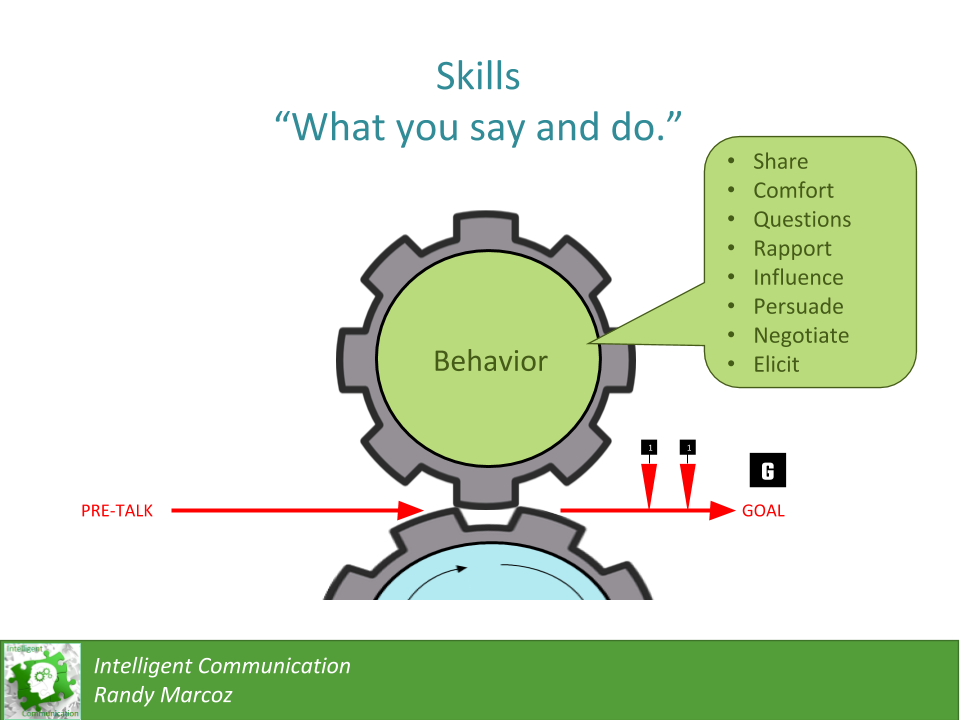
To this list I would add anything that helps you refine your understanding of others and their communication. That is anything that can help you better use the processes of the Heart. These skills might include narrative analysis and personality profiling. Remember, we do not use these skills simply because they are good communication skills in and of themselves. We select the skills that will help us achieve our goals and interim objectives for the specific interaction. We should never lose sight of that. Intelligent Communication is always a goal-focused approach
In this short lesson, I wanted to show you that what we say and do is just one of the important components of effective communication. While we need to spend time developing these skills, they will not be truly effective until we use them in conjunction with the Guideline and all the parts of the Heart. As you learn new communication skills, I want you always to consider how they will help you achieve your goals and how you will process the information you get when using them. It is all these things working together that make communication effective.
Practical Exercise
For this lesson, the practical exercise is going to be a little different. Rather than encourage you to use what you have learned in this lesson, I want to consider how you want to use the information. Think about the situations in your life when you really want to communicate effectively. For each of these situations, think about the goals you generally want to achieve. Based on this information, identify the communication skills you believe you should learn or improve to help you accomplish your goals in these important parts of your life. They may be some of the skills we listed above. You may come up with some others. Whatever they are…write them down. In addition to developing your ability to effectively use Intelligent Communication in your communication, this list will be your guide for personal communication development.
This is a relatively easy practical exercise. Just because it is easy, does not mean that it is unimportant. Take the time to do it. It should not take you too long. If you have time, I would recommend you do it right now. I’ll be sending the last lesson in this course next week.
Be quick to hear and slow to speak,
rjm
Discover more from Intelligent Communication
Subscribe to get the latest posts sent to your email.
 Intelligent Communication