
EMPATHY AND UNDERSTANDING
We have arrived at lesson seven. If you have hung in there and worked through all the practical exercises, congratulations. You are on your way to becoming an effective communicator; one who can use communication as a tool to achieve goals. If you have just discovered this course, I recommend you go back to lesson one and start there. You can find lesson one at this link.
Remember, completing the practical exercises and applying this new learning in your life now is vital if you want to develop good communication habits. So, I hope you are not cheating yourself by skipping the practical exercises or only putting in minimal effort.
Intelligent Communication and Personality
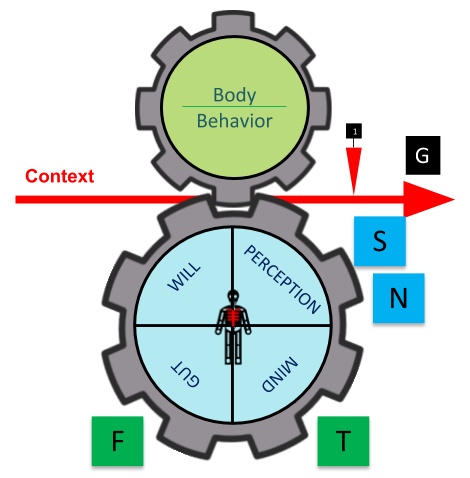
The third part of the Heart is the Gut (feeling). In ancient anthropology, the seat of our emotions was not in the heart like today, but in the bowels or the gut. Like thinking (the Mind), feeling (the Gut) is a key cognitive function. In type psychology, thinking and feeling are judging functions. They describe the two ways we prefer to make decisions. That is what we are preparing to do with these parts of IC 3.0. We are analyzing and integrating the information we have perceived and our developing what to believe about these messages. Those with a preference for feeling will be more comfortable with the Gut part of IC 3.0. Those who prefer thinking will have a similar affinity for the Mind.
Additionally, the order of how we use the Mind and the Gut may change based on our preferences. If we prefer thinkIng, we will likely go to the mind before the gut. Those who prefer feeling will tend to use their guts before their minds. The order is really not that important. We need to both our minds and our guts to achieve full understanding.
The other two cognitive functions in personality type are sensing and intuition. These are perceiving functions that describe ways we prefer to process information. As perceiving functions, these involved in the Perception part of the heart. Look at the graphic below to see the relationship between IC 3.0 and personality type. There is a connection between Intelligent Communication and the attitudes (introversion and extraversion) and orientations (judging and perceiving) as well. I address these in my personality and profiling courses.
The Gut (Feeling)
So let’s take a look at the gut. While the gut, like all the parts/processes of the heart, are internal actions, we cannot allow ourselves to become too internally focused. Using feelings associated with the gut reminds us that communication involves more than just one person. We need to consider the messenger and not just the message. That is a particular characteristic of the feeling cognitive function. The feeling function tends to deal with people first, problems/issues second. We might refer to this as empathy.
With feeling, we must consider the message from the sender’s point of view. This is particularly important when we believe the other person is quite different from us. An over-reliance on our own thoughts developed in our minds may lead us astray, if not tempered by considering the other person in our gut.
In order to make the most of feeling, one of our interim objectives is often to learn specific things about the other person. For example, we may want to develop a personality profile, identifying his/her preferences. This will particularly help us to grasp the message from his/her position.
Practical Exercise
At this point, let’s get ready to apply feeling in our communication. If your personality includes a feeling preference, you are probably looking forward to this practical exercise. You may have found the previous lesson on thinking a little more difficult. If you have a thinking preference, this practical exercise may take a little more effort to complete. It is important that you make the effort, just like it was important for those with a feeling preference to practice thinking in the previous step. Remember the following formula:
Thinking + Feeling = Full Understanding
How do we practice the feeling step? One way is to simply ask ourselves some questions. The fundamental question is: “Based on what I know about him/her, what does he/she mean?” We might want to ask, “What could I learn about him/her that would help me understand this more clearly? This second question may very well lead to an action we will later take as part of the behavior component of Intelligent Communication. We will make that decision with our Will. We will cover that in the next lesson.
So get started practicing your gut in communication. Try to understand others’ communication from their point of view. Perhaps a good place to start is with those closest to you. You know more about them and you will also likely experience some immediate benefits from understanding them better. This step takes practice, so take the next week to practice before receiving the next lesson.
Be swift to hear and slow to speak,
rjm
Discover more from Intelligent Communication
Subscribe to get the latest posts sent to your email.
 Intelligent Communication