
THINKING CRITICALLY
We have arrived at lesson six in this course. That means we are now over halfway through this course on Intelligent Communication 3.0 (IC 3.0). If you have not completed the previous lessons, I recommend you go back to the beginning of the course and start there. You can access lesson 1 by going here.
For those who have completed the first five lessons, “Are you becoming a more effective communicator yet?” It is my hope that you are. Further, I am confident that if you read these lessons carefully and apply the learning with the practical exercises, you will see results. You will be a better communicator. So how did the listening practice go? Did you find that you really gained a great deal more useful information when you really listened and did not worry about the response? The time to plan our response will come, but we should not skip using all parts of our inner person (the Heart) to get to it. When we skip too quickly to responding to others, we have very little information with which to work. When we take our time and engage all the parts of the Heart, we will have plenty of useful information to guide our responses
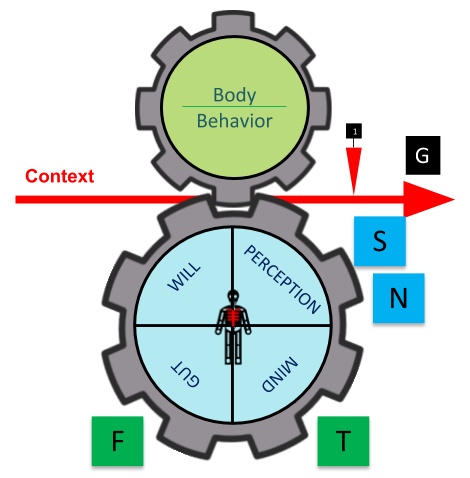
Thinking and Feeling
The second part of the Heart is the Mind (Thinking). When I first updated the original Intelligent Communication model and developed Smart Talk, I called the Mind and the Gut parts Think & Feel. All four parts of the Heart are important, but the Mind (thinking) and the Gut (feeling) are central. Thinking and feeling are two key cognitive processes in the concept of personality type. I use this concept of personality in many of my training programs, as I find it particularly useful with communication. Intelligent Personality-Intelligent Profiling is one of my most popular training seminars and it is one of the first courses I am developing for online learning. I also offer assessments online to help people learn more about their own personality.
Critical Thinking
Let’s turn our focus to thinking. Using our minds and thinking critically answers the question, “What could the information mean?” There are two things to keep in mind when using our minds in IC 3.0. The first is that thinking involves the creation of hypotheses as to what the information could mean. I chose the word hypothesis carefully. A hypothesis is a tentative assumption made in order to draw out and test its logical or empirical consequences. We test our hypotheses as we apply all parts of our hearts repeatedly.
The other aspect of thinking is implied by the first. Note that I used the plural hypotheses. We should create and consider more than one hypothesis as to the meaning of the message we receive. Having multiple hypotheses helps us to avoid potential issues like the primacy effect and belief perseverance. These are two key cognitive biases that can adversely impact your thought processes and skew our understanding of others’ communication. You can learn more about cognitive biases and how we use Intelligent Communication to combat them in this blog article. Note: this article uses the Smart Talk model.
Thinking And Logic
When we apply the thinking step to communication, we are focused on applying objective logic to our understanding of others’ communication. We should also be conscious of the negative side of logic during this step. We must identify the presence of logical fallacies in others’ statements. Failure to do this can lead us to accept an argument that is not logically supported. You can find out more about logical fallacies in this blog article. I have included a copy of the Logical Fallacy Scorecard referred to in this article. Download it here: Logical_Fallacy_Scorecard_v2.pdf
Practical Exercise
It is once again time to practice what we have learned in this lesson. For this lesson, I have two practical exercises for you. The first is to practice thinking by developing hypotheses. You can start out by replaying in your mind some recent interactions you have had. Recall some of what the other person said and did, as well as how you understood his/her words and actions. Then develop one or more additional hypotheses as to what the other person could have meant. After you do this a few times, try applying the Intelligent Communication way of thinking to your current interactions.
The second practical exercise is to practice identifying logical fallacies. So, download the Logical Fallacy Scorecard and print out a copy. Learn the logical fallacies listed on the scorecard and be attentive to identify when someone is using one. As I mentioned in the article cited above, politicians and political ads are good sources of practice. Perhaps you can find some ads on YouTube and use them for practice sessions.
That is a lot of work for you to do to apply this lesson. Take the next week to work through these practical exercises. I will post lesson seven next Monday.
Be quick to hear and slow to speak,
rjm
Discover more from Intelligent Communication
Subscribe to get the latest posts sent to your email.
 Intelligent Communication