
Communicate with a Goal
If this your first time accessing the Introduction to Intelligent Communication series, I recommend you go to the bottom of this article, where there are links to the preceding parts. As each part builds upon the previous lessons, I recommend you complete those lessons before returning to Part 3.
Welcome to part 3. Did you do the practical exercise? I cannot stress enough the importance of the practical exercises. By working through them you will be better able to begin using Intelligent Communication in your own life. We are trying to make it easier by keeping each lesson short and focused. We are also trying to create a habit by having you apply more deliberate practices to your communication each day over a period of a ten weeks.
The Guideline
We are done with the more introductory lessons and with this lesson we will begin to break down the model and look at the specific parts. We begin with the Guideline. See the Guideline displayed in the graphic below.
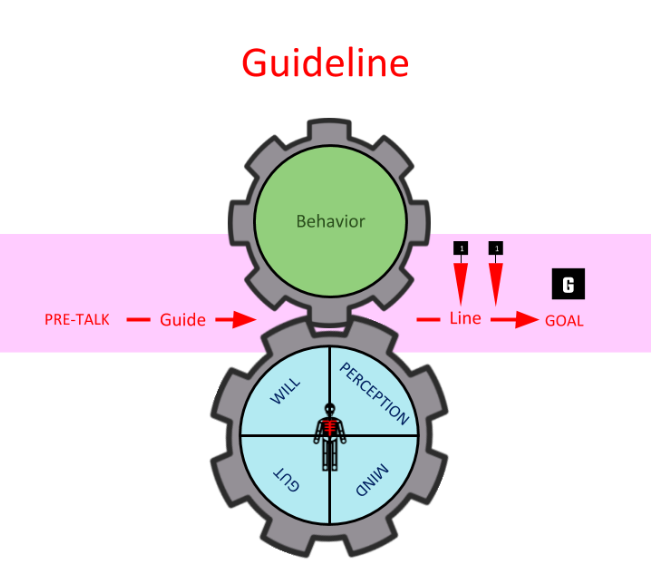
The key to the Guideline is to keep our interactions with others on track. The Guideline provides the basic path we should follow. That path begins with Context, continues through Interim Objectives, and ends at our Goal. Let’s look briefly at each of these sub-parts to the Guideline.
Context
Context describes the consideration we do prior to the interaction. What is the context of the interaction we are going to have? In this course, let me share one simple technique to help you use context. Prior to your meeting, interview, sales call, etc., answer the following basic interrogatives about the interaction: Who, What, When, Where, Why, and How.
Consider going a few levels deep on each question to ensure you really understand the context. Here’s an example of going a few levels deep. Who am I meeting? Bob Smith. Who is Bob Smith? He manages an account for Acme Widgets. Who really is Bob Smith? You go deeper with this question by thinking about what you know about Bob, his likes, dislikes, personality preferences, etc. You can also do some research to collect more information about Bob, going a little deeper still. You then do the same process with the remaining interrogatives. At this point, you will have a very good understanding of the context.
Goal
When I teach this part of the model during my Intelligent Communication Course seminars, I always ask the students if they can recall a time when they entered an important meeting without knowing what they wanted to accomplish during the meeting. Each time, just about everyone’s hand goes up. This is a common issue. And it does not just apply to meetings. It should apply to each time you pick up the phone or start writing an email. We need to have a goal. Communicating without a goal is one of the biggest obstacles to effective communication.
Setting goals for our communication is not difficult, it is just neglected. This is one of the most important aspects of the Intelligent Communication model. It provides a reminder of those important aspects of effective communication that we tend to forget. As you begin applying this part of the model during your practical exercise for this lesson, you will begin building a good habit that should become automatic through practice.
Goals and Objectives
The final concept I would like to share in this lesson is the idea of goals and objectives and how they are used in Intelligent Communication. These two words are often synonymous. In this model, however, they describe different and important aspects of effective communication. Let’s take a look at how we use them in Intelligent Communication. We will use a football (that is American football) analogy. See the graphic below.
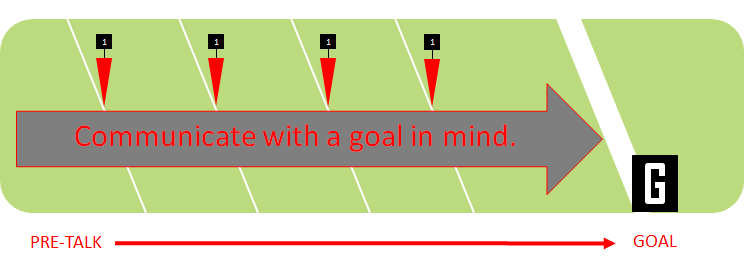
When I use the term goal, I am referring to the ultimate goal for the interaction. In our football analogy, this is the goal line. But, in football, teams do not score a touchdown on every play. Often, they are just trying to make a first down. This allows them to keep the football and moves them closer to their ultimate goal: a touchdown. We should do the same thing in our communication. We should identify interim objectives that will help us and move the interaction closer to our ultimate goal.
Let me give you an example I used in an article I wrote for my blog that dealt with the importance of communication skills for medical professionals. During a medical appointment, the goal for a medical professional might be a treatment plan for the patient. Before they can achieve that goal, they will have a number of interim objectives. These might include: review the patient’s current vitals, get a brief medical history, identify the patient’s symptoms, and make a diagnosis. They may also consider adding an interim objective of establishing rapport. I recommend that this be a common interim objective, as having rapport makes many other communication techniques/skills much more effective.
Okay, there you have a brief introduction to the Guideline. I understand that I covered a lot of information in a brief email. If you are interested in going deeper, I am in the process of developing an online course with video lectures and more practical exercises. This is part of my goal to convert all my seminar programs into online learning courses. Producing an expanded online course on Intelligent Communication is one of my interim objectives. I will be sure to let you know when it’s ready.
Practical Exercise
At this point, our practical exercises are getting specific. Further, they will lead us to begin using Intelligent Communication in our own lives. I want you to begin using all three aspects of the Guideline and you will have the next week to practice them before I post the next lesson.
So, this is what I want you to do. Pick an upcoming interaction (meeting, interview, etc.) to begin. Prior to that interaction, work through the three aspects of the Guideline.
- Ask yourself the basic interrogatives about the interaction: who, what, when, where, why, how.
- Determine your goal. What do you want to accomplish?
- Identify a few interim objectives that will help you along the way.
After the interaction, do an after-action review with yourself. How did it go? How did a basic application of Intelligent Communication help? After you do this, review this lesson. If you want, post a comment let me know how it went. I look forward to hearing from you.
After you do all this…do it again and again and again. After all, we are trying to develop a habit here.
See you next week for Part 4, where we will begin looking at the Heart of communication.
Be quick to hear and slow to speak,
rjm
- Introduction to Intelligent Communication Blog Series
- Introduction to Intelligent Communication — Lesson 1
- Introduction to Intelligent Communication — Lesson 2
Discover more from Intelligent Communication
Subscribe to get the latest posts sent to your email.
 Intelligent Communication
2 thoughts on “Introduction to Intelligent Communication — Part 3”